
Autumn Conference 2026
Why International Development Matters for Britain
Brighton, 20 September 2026
At our Autumn Conference event in Brighton, parliamentarians, practitioners, researchers and advocates made the case for international development as part of conflict prevention, national security and a fairer global order.
On 20 September, Liberal Democrats in International Development (LDID) brought together speakers from Parliament, the World Food Programme, the Institute of Development Studies, the London School of Economics, Mines Advisory Group, United Against Malnutrition and Hunger, Bond, the ONE Campaign and the Coalition for Global Prosperity for an afternoon of discussion alongside the Liberal Democrat Autumn Conference. Across three panels, they explored the politics of development in an age of populism, the relationship between hunger and instability, and the opportunities presented by the United Kingdom's forthcoming G20 presidency.
One message returned throughout the afternoon: international development cannot be separated from Britain's domestic interests. It helps the UK prevent crises, sustain democratic institutions, protect civilians and strengthen the multilateral system on which its security and prosperity depend. Speakers also recognised that this case has not been made consistently or confidently. Rebuilding public support will require credible policy and a language of solidarity, justice and shared interest that connects international action with the kind of country Britain wants to be.
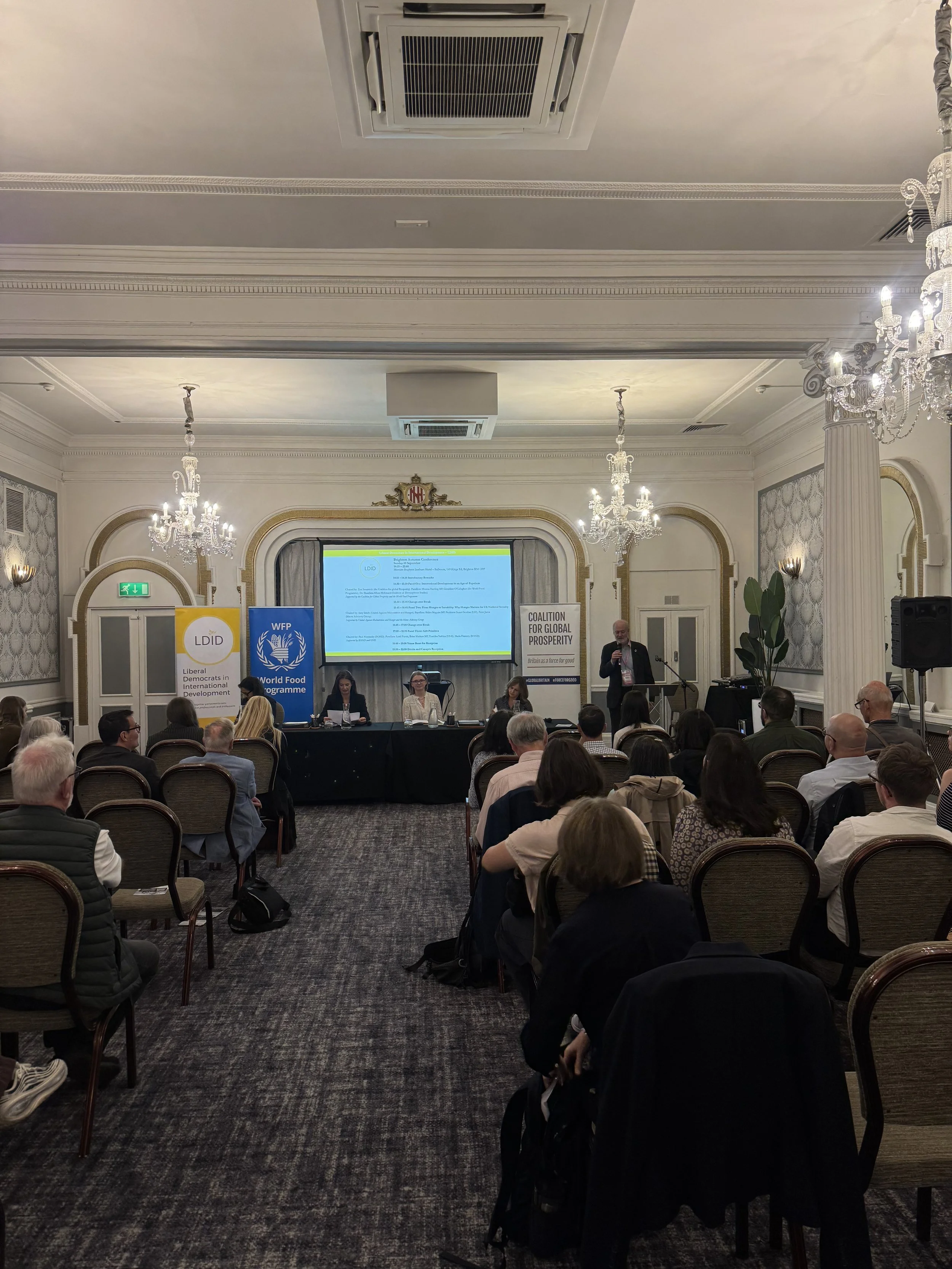
Making the case for internationalism
The first panel, International Development in an Age of Populism, was chaired by Zoe Swanwick of the Coalition for Global Prosperity. She was joined by Monica Harding MP, Geraldine O'Callaghan of the World Food Programme and Dr Shandana Khan Mohmand of the Institute of Development Studies. The discussion considered how to defend and use international development budgets in a political environment increasingly shaped by populism, polarisation and fiscal retrenchment.
Speakers cited a 17 per cent fall in humanitarian and development funding in 2025, with around 300 million people requiring humanitarian assistance. They argued that the consequences reach beyond immediate relief. Long-term work on governance, human rights and conflict prevention is often the first casualty, leaving organisations to respond after the opportunity to prevent a crisis has already been lost.
The withdrawal of the United States, the United Kingdom and other major donors also changes the geopolitical landscape. Harding warned that abrupt cuts leave space for more transactional models of engagement and weaken British influence in regions of growing strategic and economic importance. Private investment has a vital role, but it cannot simply replace grant finance in fragile and conflict-affected states where risks are highest and the need for patient institution-building is greatest. Mohmand reinforced the importance of sustained support: building state capacity and durable relationships between governments and civil society takes decades, while sudden withdrawal can undo progress very quickly.
The panel also examined why the public case for development has struggled. British voters often overestimate the share of national income spent on aid while underestimating what it achieves. Speakers argued that successive governments have discussed development too defensively and too often as a budget line, bending it towards short-term domestic pressures. That has made it harder to explain its moral purpose and practical value to Britain.
Harding proposed making the case at three connected levels: the moral imperative, the strategic imperative and the need to change the story Britain tells about its place in the world. Support for global development should be rooted in national values rather than presented as distant charity. Climate, health, nutrition, conflict, forced migration and economic insecurity cross borders, so investment in prevention overseas can protect lives while reducing risks that eventually reach the UK. She also defended the 0.7 per cent aid target as an expression of sustained ambition, not a commitment to be abandoned when it comes under attack.
Mohmand linked the communication challenge to the health of democracy itself. Populism and polarisation draw power from a division between a supposedly pure people and a corrupt establishment, often intensified in Britain by debates about immigration. Rebuilding support for internationalism requires more than better slogans: citizens need to feel that they have a meaningful voice in domestic governance. More inclusive and responsive democracy can create stronger foundations for global solidarity.
O'Callaghan stressed the need to understand where people now obtain information and how short, emotionally direct messages shape opinion. Narratives centred on solidarity, justice and practical results are more likely to resonate than descriptions of abstract funding gaps. She also described how the World Food Programme is supporting national systems, advancing localisation, and using innovation and artificial intelligence to strengthen early warning and improve efficiency. Those reforms should make development more effective, but they should not disguise the scale of the resources being withdrawn. For Liberal Democrats, the opportunity is to connect internationalist values with a clear account of how development strengthens Britain's security, influence and prosperity.
Why hunger matters for national security
The second panel, From Hunger to Instability: Why Hunger Matters for UK National Security, was chaired by Amy Smith of United Against Malnutrition and Hunger. The speakers were Professor Stuart Gordon of the London School of Economics, Peter Jones of Mines Advisory Group and Helen Maguire MP.
The discussion drew on Gordon's report From Hunger to Instability: Why Global Hunger Matters for UK National Security. Its central argument is that hunger is not only a consequence of conflict and instability; it can also be a driver. When food becomes unaffordable, private hardship becomes public grievance. Armed groups can exploit dependence to recruit, control communities and restrict access to essential supplies. Malnutrition also weakens economies, public finances and the ability of societies to withstand the next shock.
The report's practical significance lies in prevention. Food price spikes, failing systems and declining access to nutrition often provide warning signs before a wider security crisis develops. Used together, these indicators can help governments act earlier. Gordon proposed incorporating food access and nutrition into conflict-risk assessments, using diplomacy to protect civilian supply routes, and establishing predictable multi-year finance with clear triggers for responding to shocks. Defence and development analysis should also examine together how food systems affect recruitment, displacement and state stability.
This bears directly on the UK government's decision to reduce official development assistance to 0.3 per cent of gross national income by 2027 in order to finance higher defence spending. The panel questioned whether the net security cost of that transfer had been assessed. Treating aid and defence as competing pots can obscure the contribution that nutrition, resilience and conflict prevention already make to national security. Gordon also cautioned against using humanitarian assistance simply as a short-term instrument for winning influence: the needs and rights of people facing hunger remain the starting point.
Jones grounded the discussion in the work of Mines Advisory Group (MAG). Clearing landmines, cluster munitions and other explosive remnants protects civilians and allows homes, farms and local economies to function again. In 2024, MAG removed more than 35,000 mines and other remnants of war, made over 16 million square metres of land safe, and destroyed more than 16,000 small arms and light weapons. The connection with food security is direct: land cannot return to productive use until people can cultivate it safely. With conflict, displacement and explosive-weapon casualties rising, this is both humanitarian work and long-term investment in stability.
Maguire argued that defence and international development have been institutionally separated for too long. Climate, health, food, economic and human security are mutually dependent, and policy should reflect that reality. She called for renewed investment in aid and a return to the 0.7 per cent target, while urging the UK to use its soft power more fully and learn honestly from what does and does not work in different countries. Prevention presents a familiar political difficulty: as with preventive health spending, its benefits are long term and often invisible precisely when it succeeds. Government accounting and decision-making need to be better equipped to recognise that value.
Participants also noted that the word development can evoke corruption, failed projects or remote institutions for parts of the public, whereas famine, disease, pandemics and climate risk feel more concrete. The answer is not to abandon humanitarian principles, but to explain how early action serves both human dignity and shared security. Amy Smith closed with an example from a community clinic in rural Kenya, where locally recruited nurses reported falling child mortality and malnutrition after UK-funded services arrived. It was a practical reminder of the measurable change that sustained prevention can achieve.
A development agenda for the UK G20 presidency
The final panel, G20 Priorities, was chaired by Paul Abernethy of Bond and brought together Lord Purvis of Tweed, Brian Mathew MP, Tuwilika Nafuka of the ONE Campaign and Maria Finnerty of Bond. The discussion looked ahead to the UK assuming the G20 presidency in December 2026 and asked what credible British leadership would mean for marginalised communities at a time of conflict, debt distress, aid cuts and pressure on multilateral institutions. Speakers agreed that expectations should be realistic, but that the presidency offers a rare opportunity to bring countries with very different interests together around a limited set of practical priorities.
Lord Purvis identified several areas where common ground could be pursued: protection of civilians in Sudan, a shared commitment to ending absolute hunger, protection and rapid restoration of education during conflict, and recognition that development spending supports rather than competes with security. Recent failures to reach agreement in multilateral forums, he argued, should prompt renewed diplomacy rather than resignation. For Liberal Democrats, the task is to work with liberal partners internationally to defend a rules-based system against a more transactional world of spheres of influence.
Mathew emphasised people-centred development. Policy should begin with the priorities of affected communities and enable locally owned solutions rather than impose distant models. Water, sanitation and hygiene are foundational to health, food, climate, economic and human security, yet large-scale finance too often remains concentrated in towns and cities rather than reaching the poorest communities. He also highlighted the value of flexible local funds that allow diplomatic missions to support effective grassroots initiatives.
Nafuka urged the G20 to measure success in human rather than purely financial terms. Preventable illness and malnutrition still determine whether children survive and whether national health systems can become resilient. Consultation must reach beyond well-funded organisations in capital cities to schools, grassroots groups, local leaders and communities that are routinely excluded. Putting women and girls at the centre requires more than mainstreaming language: it requires transparent programmes, trackable resources and decisions shaped by those most affected.
Finnerty widened the discussion beyond aid. Poverty and inequality are shaped by global financial rules, debt burdens, tax abuse and illicit financial flows as well as by development budgets. As a major financial centre and the jurisdiction governing much sovereign debt owed to private creditors, the UK has both responsibility and leverage. Bond's priorities include reforming the G20 Common Framework for Debt Treatments, pursuing UK legislation to prevent private creditors from obstructing fair restructurings, strengthening beneficial-ownership transparency, tightening oversight of shell companies and investing in the recovery of stolen assets.
National reform and multilateral action should reinforce one another: changes at home can build credibility and unlock wider agreement. The G20 can bring together debtor countries, traditional donors, emerging creditors, international institutions and civil society. The panel concluded that the UK presidency should connect its global agenda with the changes Britain is prepared to make at home. Leadership will be judged not by the length of its communique, but by whether it produces fairer rules and practical improvements for communities carrying the heaviest costs.
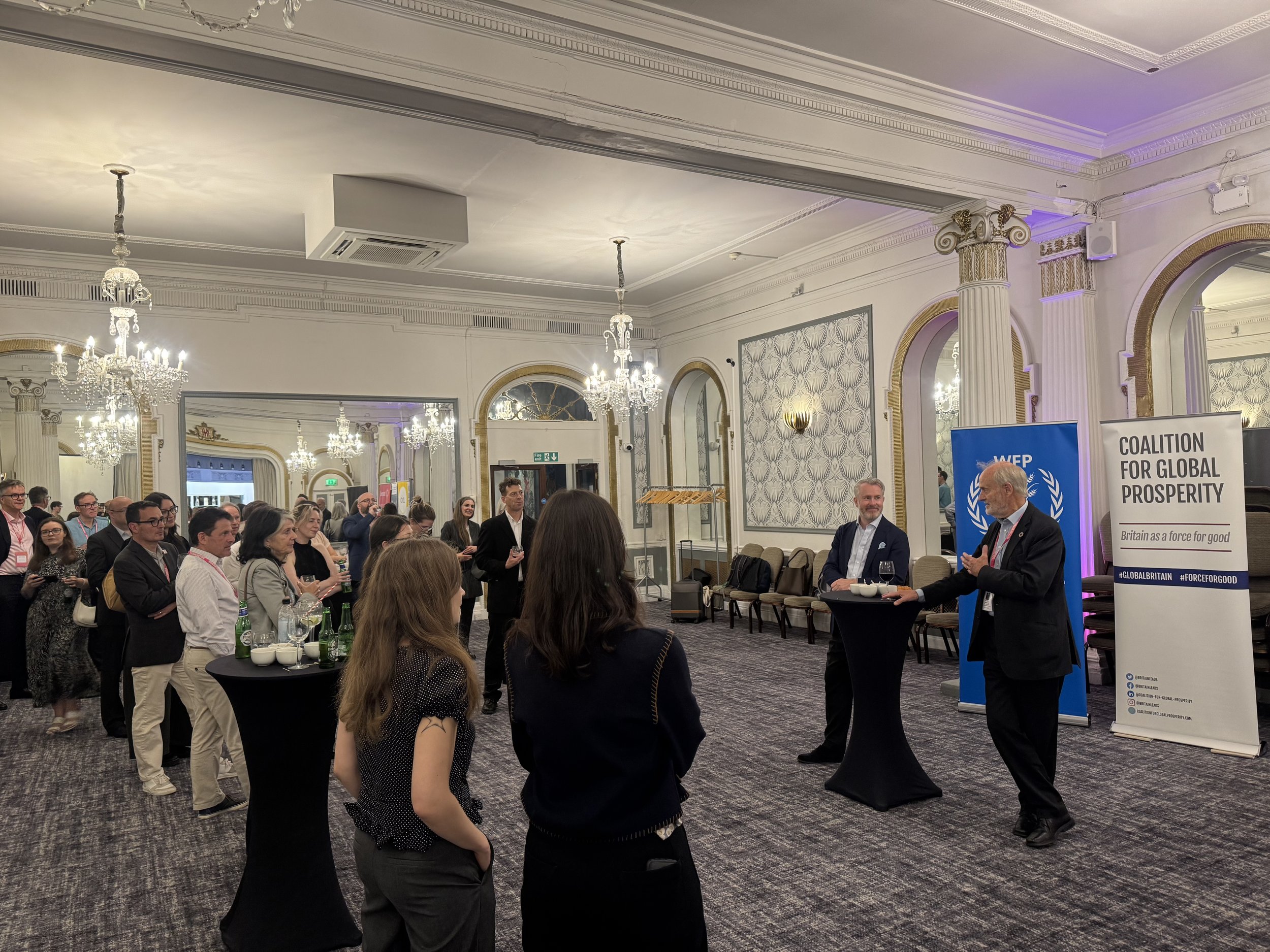
An agenda for Liberal Democrats
The discussions point to a clear political agenda. Prevention should be treated as a priority across conflict, hunger, governance and public health. Early action is more humane and usually less costly than emergency response, yet institutions and budgets often reward visible reaction more readily than patient prevention. Climate, food, health, economic and human security also need to be understood together rather than divided between competing objectives.
Rebuilding public support requires more confident and concrete language. Percentages and institutional terminology rarely move opinion on their own. The strongest case connects practical outcomes with solidarity, justice, national values and an honest account of global interdependence, while acknowledging past failures without allowing them to erase proven achievements.
Development policy also extends beyond the aid budget. Debt, tax, illicit finance, trade, climate policy and corporate transparency can reinforce or undermine development objectives. The UK's role in global finance gives it tools for reform that do not depend solely on spending decisions. National systems, local civil society, women and girls, and communities outside capital cities need more than consultation after decisions have been made. Sustainable progress depends on shifting expertise, authority and resources closer to the people whose lives are affected.
Internationalism is central to the Liberal Democrats' identity. The task is to turn that commitment into a practical programme that can rebuild public confidence: defend principled and predictable development finance, make prevention central to security policy, pursue reform on debt, tax and illicit finance, and ensure that local leadership shapes policy and delivery. The UK's G20 presidency offers an early test of how Britain can use its voice, institutions and financial influence to advance a fairer and more secure world.
LDID thanks all chairs, speakers, partner organisations and attendees who contributed to the discussions, including the Coalition for Global Prosperity, World Food Programme, United Against Malnutrition and Hunger, Mines Advisory Group, Bond and the ONE Campaign.